


Get actionable strategies every Week
Be honest: how many free PDFs did you download last year and actually read? The "reply and I’ll send you my guide" lead magnet is not converting because it is built on a broken promise. It asks the prospect, a stranger, to do the work. There is a better mechanism, and once you see it you cannot unsee it. We call it the reverse lead magnet, and it is the difference between offering homework and offering a finished result.
Strip away the tactics and lead magnets obey a single principle: perceived value rises with the effort the prospect believes you spent on them, and falls with the effort it demands of them. A generic PDF scores badly on both counts. They know you made it once and blasted it to thousands, so the perceived effort is zero, and it then asks them to spend twenty minutes reading it. Low perceived effort, high demanded effort. Straight to the archive.
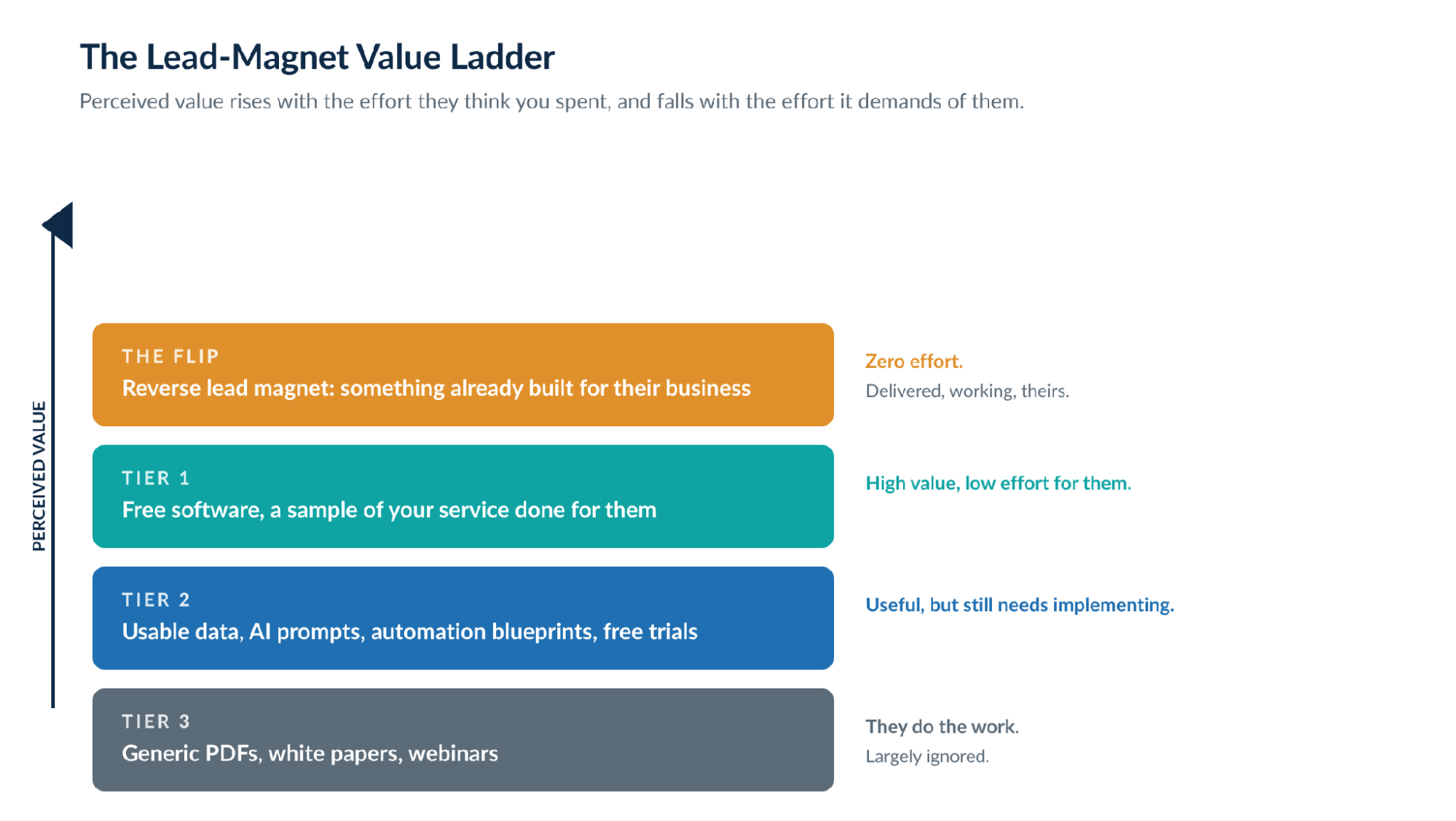
Climb the ladder and the maths improves. Usable data, AI prompts and automation blueprints beat a white paper because they are immediately useful, though they still need implementing. Free software or a genuine sample of your service done for them is better still: high value, low effort on their side. The reverse lead magnet is the flip at the very top.
Instead of giving the prospect something they have to implement, you give them something already implemented: a small, purpose-built deliverable that solves a real problem for their specific business, with zero effort on their part. You are not handing over a recipe, you are handing over the meal. A few concrete examples across verticals:
This is not new psychology, just a better delivery of an old one. The "can I record you a quick Loom?" offer worked for years for a single reason: the prospect believed you were making something one-to-one, just for them. The problem was that it did not scale, because you genuinely had to sit and record every video. The reverse lead magnet keeps the perception of bespoke effort and strips out the manual labour, because the asset is built once and personalised by software. You get the warmth of a one-to-one gesture at the cost of a mass campaign.
The words matter as much as the asset. You do not say "download my thing". You say: "Would it be okay if I spent some time building something for you?" That single line implies bespoke effort on their behalf, which is exactly the lever that lifts perceived value. The prospect pictures you working for them before they have spent a penny. When the answer is yes, you send the link to the finished deliverable, and the conversation has already shifted from "who are you" to "what else can you do".
The obvious objection is that this cannot scale, and a few years ago that was true. Modern AI tooling has changed the map. You build the asset once per vertical, not once per lead. One SEO teardown tool serves every SEO prospect; one tech-stack scanner serves every automation prospect. An afternoon of build time becomes an unlimited supply of personalised-feeling deliverables. The effort is front-loaded and then amortised across the whole list.
The same asset doubles as your retargeting hook. The page the deliverable lives on can carry your tracking pixels, so even prospects who never reply can be retargeted across platforms for pennies. Your lead magnet quietly becomes your retargeting engine.
The reverse lead magnet is a foot-in-the-door device for a competitive or commoditised offer, the situations where a plain pitch bounces off. If you already have a genuinely differentiated offer that solves an obvious, urgent problem, you may not need one at all; a clear, direct email can beat any clever hook. It also works best with small and mid-sized businesses, who feel the personal gesture most. The further up-market you go, the more the buyer simply wants the problem solved on a call rather than a gadget to play with.
And a weak reverse lead magnet is worse than none. If the deliverable is thin, generic or visibly auto-generated, it breaks the very trust it was built to create. The test is simple: build something you would be comfortable charging for, or do not send it.
One caveat to keep it honest: a reverse lead magnet is a foot in the door, not the whole sale. Its job is to earn the reply and the trust, prove you can do the work, and open the conversation. The sale still happens on the call.
Get the help: Want to see a reverse lead magnet built for your vertical? Reply and we’ll mock one up for you, no charge.
Lorem ipsum dolor sit amet, consectetur adipiscing elit, sed do eiusmod tempor incididunt ut labore et dolore magna aliqua. Ut enim ad minim veniam, quis nostrud exercitation ullamco laboris nisi ut aliquip ex ea commodo consequat. Duis aute irure dolor in reprehenderit in voluptate velit esse cillum dolore eu fugiat nulla pariatur.
Worried your domains are already burned? Reply and we’ll run a free placement test and tell you exactly where you stand. No form, no pitch, just the diagnosis.
Ordered list
Unordered list
Bold text
Emphasis
Superscript
Subscript



.svg)
