

Get actionable strategies every Week
Most cold emails get ignored, and not because the product is bad. They fail because they ask for too much, too soon, in too many words. A cold email that lands does only one job: it earns a reply. To get there it has to win three small battles in sequence, and if it loses any one of them, the other two do not matter. We call this the Triple Tap, and once you write to it you stop guessing.
Every cold email asks the prospect to take three separate actions: Open, Read, Respond. Treat them as three distinct chunks of copy, and test each one independently, because a failure at any stage hides the others. If nobody opens, the body is irrelevant. If they open but do not read, the CTA never gets seen.
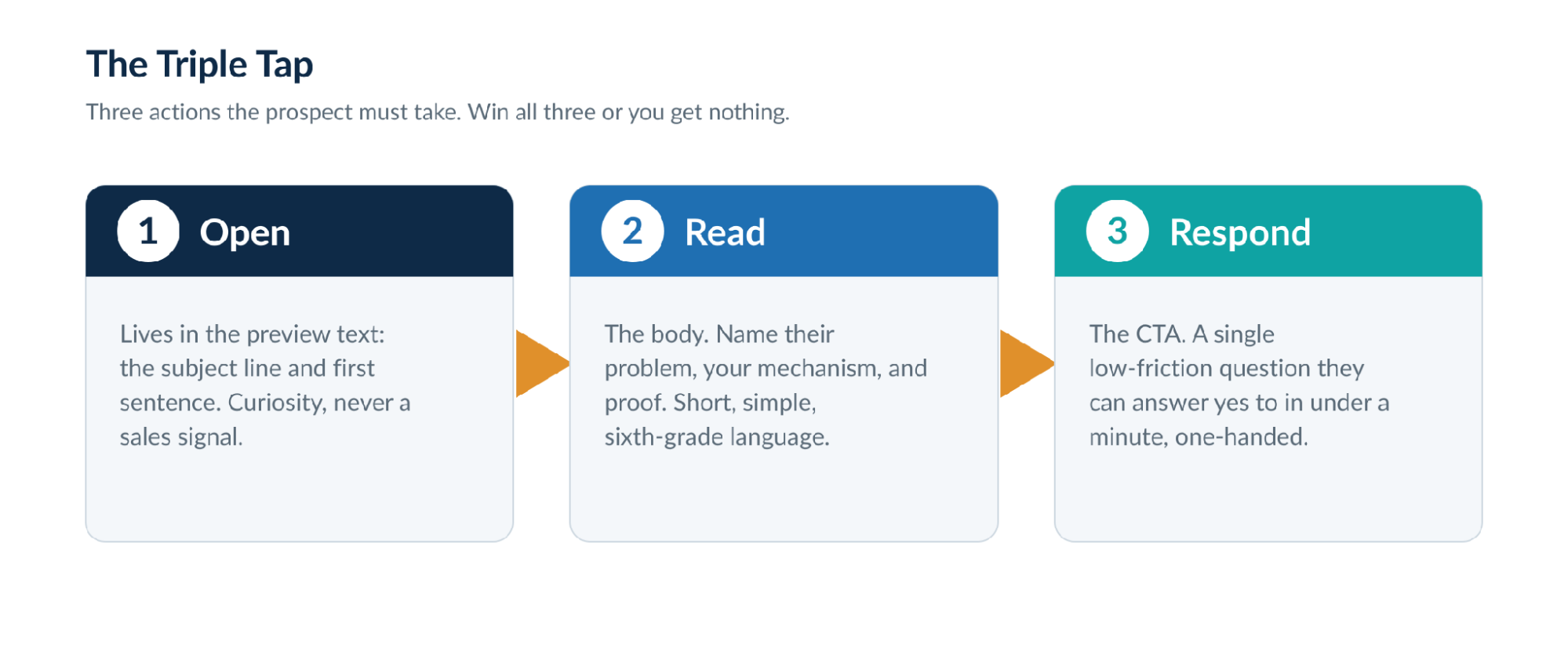
Open is won entirely in the preview text: the subject line and the first sentence, the only things visible before the decision to open. The goal is curiosity, never a sales signal. The instant a prospect can tell you are about to pitch, they archive you. Read happens in the body and must do two things only: name their problem and your mechanism for solving it, and build genuine, non-boastful credibility. Respond is the call to action, and the bar is brutally simple, covered below.
The subject and first line work as a single unit. They should make the prospect think the email could be from a client, a vendor or a partner, anything but a pitch. Four patterns earn opens reliably:
A reliable structure is subject, compliment, case study, call to action, signature, one sentence each. Follow it and the email is automatically short enough to read on a phone without scrolling, which is exactly where the best cold emails are read.
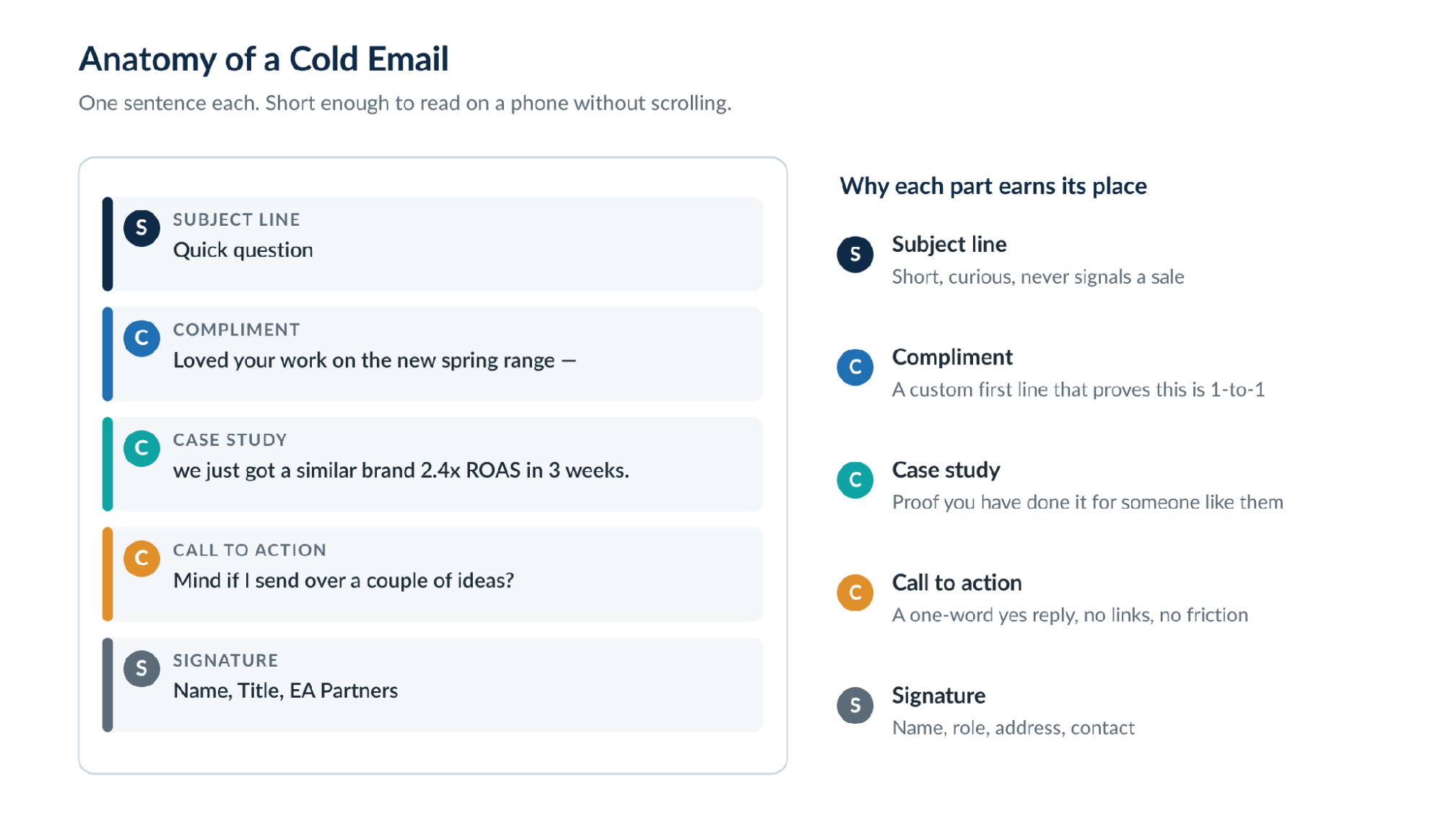
Notice what is doing the work. The subject is short and curious. The compliment is specific enough to prove a human wrote it. The case study is a brand like theirs with a concrete number. The CTA asks for nothing but a one-word yes. The signature is clean. Five sentences, readable in seconds.
The open buys you seconds, not minutes, so the body has to earn attention immediately. It has two jobs and no others. First, name the problem and your mechanism: not a vague "we help companies grow", but the specific friction this reader feels and the specific way you remove it. Second, build credibility without bragging. The strongest proof is a result for someone they recognise, a competitor or a familiar name in their space, with a number attached. If you have no case studies yet, borrow credibility from a relevant piece of content, a recognisable logo you have worked with, or a concrete process. Personalise both halves to the audience: the problem that lands for a SaaS founder is not the one that lands for a restaurant owner, and the proof that moves an agency owner is another agency, not an unrelated client. Get the problem and the proof right and the reader reaches your CTA already half-convinced.
Same five parts, same one-sentence discipline, completely different industry. Once the skeleton is in your head you stop writing emails from scratch and start filling in a proven shape.
Most emails that never get read lose at the very first tap. Three culprits account for almost all of it. First, signalling the sale in the subject. "Can we help you with X?" tells the reader a pitch is coming and earns an instant archive. Second, the visible mail-merge tell: an ALL-CAPS company name, a stray "Ltd", a [first name] that did not populate. One of those and the reader knows they are one of ten thousand. Third, length you can see before you open. If the preview shows a wall of text, it reads as effort the reader has to spend, and they will not spend it. Keep the first line short, specific and human, and let curiosity, not information, carry the open.
Low resistance is everything. No links, no asking them to click or think. The reply you want is "yes", "sure" or "send it". The test: can they reply with a single word, one-handed, in under a minute? "Mind if I send over a couple of ideas?" passes. Once they raise their hand, the rest is just sales.
More personalisation is not better; every variable you add is another chance to be wrong or to look automated. The one to always use is the first name. Beyond that, the highest-value personalisation is a single researched line of two to eight words, based on something not readily visible on a profile: a recent partnership, an article they were featured in, a detail from their site.
The reason to split a cold email into three taps is not just clarity, it is testing. Change one tap at a time and the result tells you something clean. Test three subject lines against the same body and a lift points squarely to the open. Hold the subject still and test two different bodies, and a lift points to the read. Change everything at once and you learn nothing, because you cannot tell which change moved the needle. Because we no longer track opens for deliverability reasons, reply rate is the proxy: a higher reply rate almost always means a better open or a better read, so let it be your scoreboard. Run the tests in order, open first, then read, then respond, and lock in each winner before moving to the next. That discipline is how a 1% reply rate becomes a 5% one, not luck and not a magic template.
If you remember nothing else, keep this: six sentences maximum, sixth-grade reading level, first name as the only guaranteed personalisation, and a CTA they can answer in one word. Win the open, earn the read, make the response effortless.
Get the help: Want our swipe file of subject-line patterns that consistently get opened? Reply "swipe" and we’ll send it over.
Lorem ipsum dolor sit amet, consectetur adipiscing elit, sed do eiusmod tempor incididunt ut labore et dolore magna aliqua. Ut enim ad minim veniam, quis nostrud exercitation ullamco laboris nisi ut aliquip ex ea commodo consequat. Duis aute irure dolor in reprehenderit in voluptate velit esse cillum dolore eu fugiat nulla pariatur.
Worried your domains are already burned? Reply and we’ll run a free placement test and tell you exactly where you stand. No form, no pitch, just the diagnosis.
Ordered list
Unordered list
Bold text
Emphasis
Superscript
Subscript



.svg)
