


Get actionable strategies every Week
If your replies dried up overnight, the problem usually is not your offer and it is not your copy. Your mail is sitting in the spam folder, where the greatest email ever written earns exactly nothing. Here is the reassuring part: landing in spam is a rite of passage for anyone who sends at volume, and there is a precise order for climbing back out. This is that order. Before you rewrite a single line or buy a single new mailbox, work the protocol below.
Your email travels through a chain of components, and each one carries a reputation score that rises or falls with how your mail is treated. From most important to least, it is the sending IP, then the domain, then the individual mailbox. The scores cascade. If one mailbox gets burned by spam complaints, you simply create a new one under the same domain. But if the domain lands on a blacklist, every mailbox beneath it falls with it.
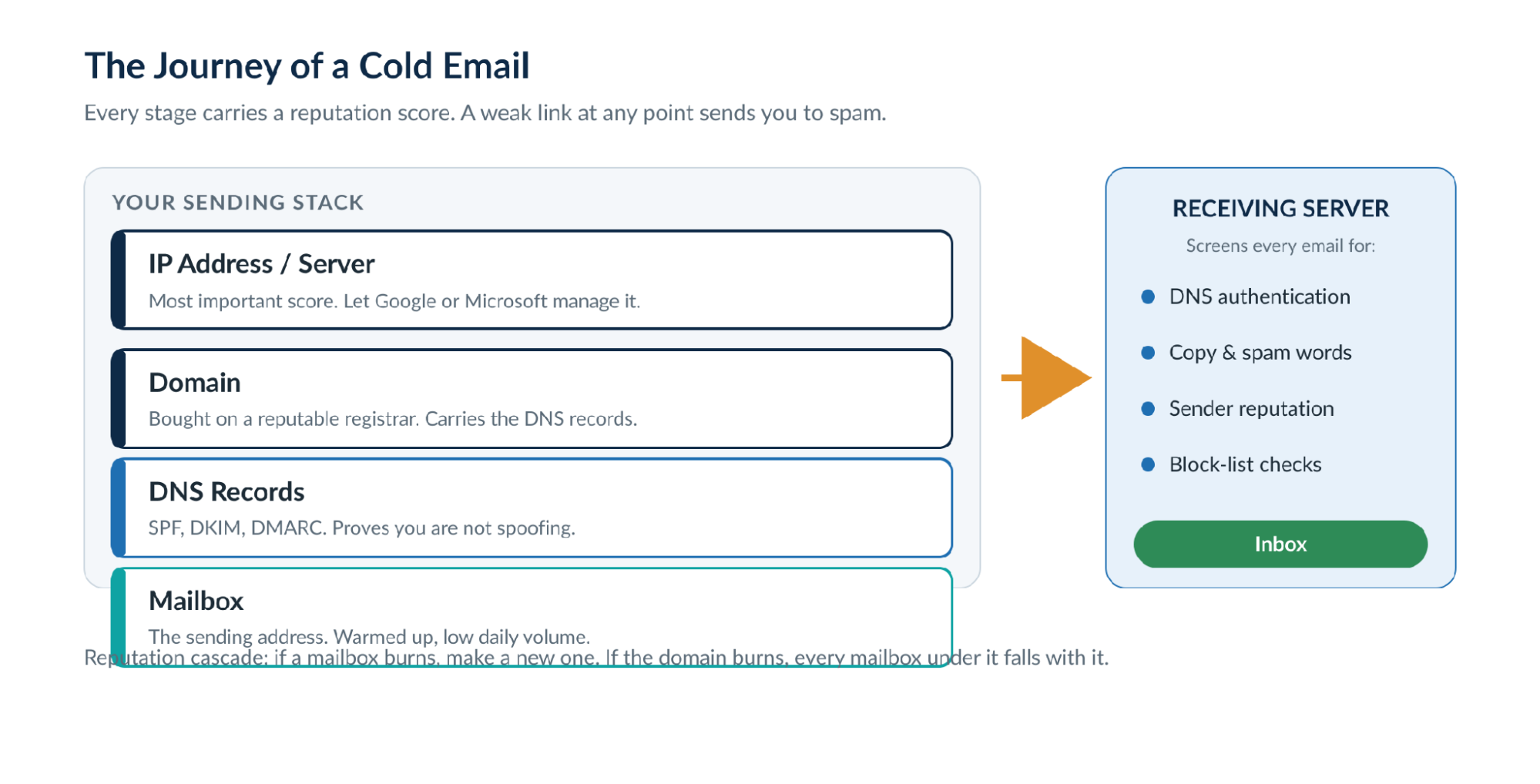
This is why you never send cold email from your primary company domain. That domain is sacred. One bad list, one spike of complaints, and your whole company’s email is affected. Use dedicated sending domains that you can afford to lose.
And the single biggest cause of spam placement is not technical at all: it is people reporting you. No filter trick survives a stream of spam complaints. That is why relevance is not a courtesy, it is a deliverability mechanism. Email the wrong people and you generate the exact signal that buries you.
When deliverability drops, do not panic and do not keep sending. Work the loop in order. The longer you have been in spam, the harder it is to climb out, so move fast, but move in sequence.
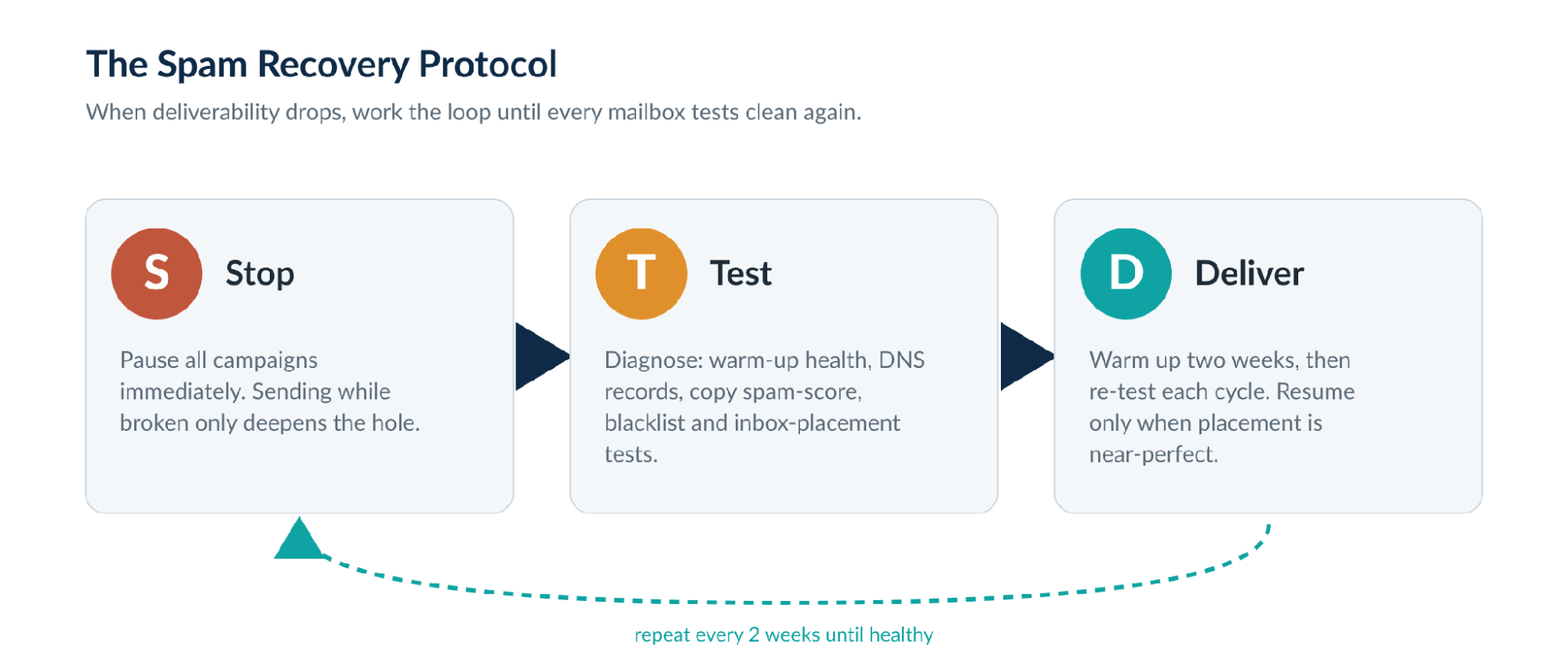
Pause every campaign immediately. Continuing to send while you are flagged only deepens the hole and trains the filters further against you. This pause is temporary, but it is non-negotiable.
Now diagnose the cause. Run these five checks, in roughly this order, and let the results tell you where the problem sits.
While you are in the data, check two numbers: keep your bounce rate and unsubscribe rate each under five percent. High bounces, usually from unverified lists, blacklist you faster than almost anything else.
Once you know the cause, the treatment is almost always the same regardless of the diagnosis: warm the affected mailboxes for around two weeks, then re-test. Do not resume sending from a mailbox until it tests near-perfect. Re-run the placement test every cycle until it is clean. If a mailbox simply refuses to recover, retire it and spin up fresh domains and mailboxes on diversified infrastructure rather than fighting a lost cause.
Plan for weeks, not days. A mailbox that has only just dipped can often be nursed back in a single two-week warm-and-re-test cycle. One that has been sitting in spam for months may need two or three cycles, and a few never fully recover. That is not a flaw in the protocol, it is the cost of having sent while broken, which is exactly why Step 1 is to stop.
Set expectations with the team accordingly: the campaign is paused for a fortnight at minimum, nobody sneaks out a "quick test" blast to check, and progress is judged only by the placement test, never by gut feel. If a mailbox has been through three full cycles and still tests poorly, stop trying to save it. Retire that mailbox, and if several on the same domain are affected, retire the domain too. Rebuild on a different provider so you are not standing the new system back up on the same compromised foundation.
Two reflexes make everything worse. The first is to keep sending, hoping volume outruns the problem; it does the opposite. The second is to panic-tweak the copy at random, changing five things at once so that even if placement recovers you have no idea why. Diagnose first, change one thing, re-test. Random fixes turn a solvable problem into an unsolvable one.
The campaigns that never see the spam folder share three habits: low-and-slow volume (roughly 20 to 25 sends per mailbox per day, ramped gently), diversified domains and mailboxes so no single failure sinks the system, and clean, relevant, verified lists so complaints stay near zero. Get those right and the protocol above becomes something you rarely need.
Two more habits keep you clear. Verify every list to "good" before it touches a mailbox. And warm every new mailbox for a full two weeks before its first real send, so it starts life with a reputation rather than borrowing against one it does not have. None of this is glamorous. All of it is the difference between a channel that compounds quietly in the background and one that dies the first time you push it too hard.
Get the help: Worried your domains are already burned? Reply and we’ll run a free placement test and tell you exactly where you stand. No form, no pitch, just the diagnosis.
Lorem ipsum dolor sit amet, consectetur adipiscing elit, sed do eiusmod tempor incididunt ut labore et dolore magna aliqua. Ut enim ad minim veniam, quis nostrud exercitation ullamco laboris nisi ut aliquip ex ea commodo consequat. Duis aute irure dolor in reprehenderit in voluptate velit esse cillum dolore eu fugiat nulla pariatur.
Worried your domains are already burned? Reply and we’ll run a free placement test and tell you exactly where you stand. No form, no pitch, just the diagnosis.
Ordered list
Unordered list
Bold text
Emphasis
Superscript
Subscript



.svg)
