


Get actionable strategies every Week
Most marketing channels are a guessing game. You pour money into ads and hope the pipeline shows up. Cold email is different, and it is the difference that makes it the most defensible line in a growth budget: the volume is predictable. You can start from the number you actually care about, the sales target, and work backwards to exactly how many emails you need to send each day, and therefore how many mailboxes to run. No hoping required.
The chain runs backwards from revenue to daily activity. Each link is a conversion rate you can measure and improve:
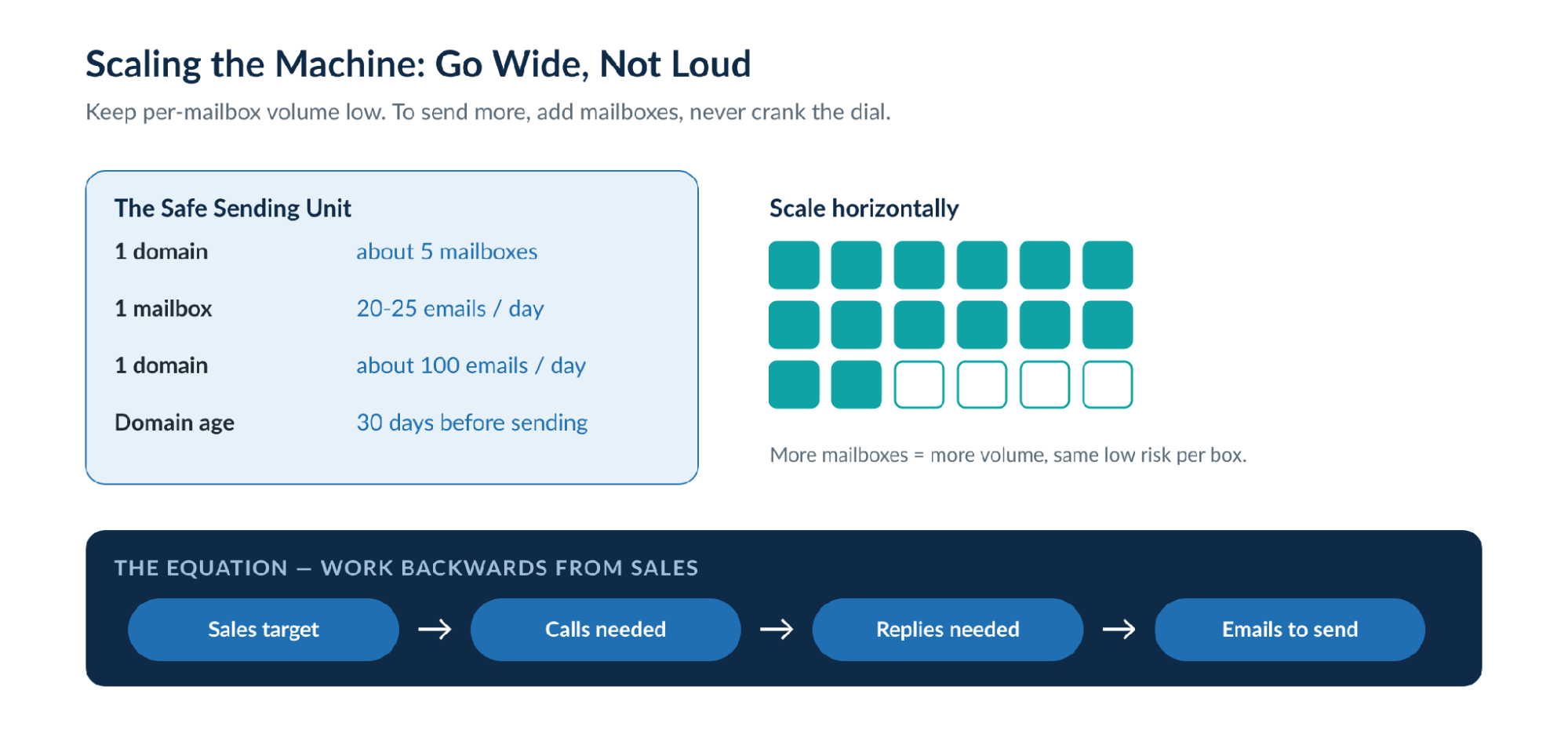
Sales target, then the calls needed to hit it, then the positive replies it takes to book those calls, then the emails it takes to earn those replies, then the daily send volume, then the number of mailboxes. Plug your own numbers in at each step and the guesswork disappears.
Say you want 4 new clients a month. Use deliberately specific numbers from your own data rather than round ones, because crooked numbers are both more credible and more accurate. Suppose:
That is the whole point: a vague ambition ("get more clients") becomes a concrete operating spec ("run 12 mailboxes at 22 sends a day"). And every link in the chain is a lever. Lift the reply rate or the close rate and the required volume drops.
Every number in the chain is a multiplier, so improving the ones nearest the sale pays off fastest. Lifting your close rate from 1-in-5 to 1-in-4 cuts the emails you need by a fifth, for zero extra send volume. Sharpening the offer so the reply rate moves from 2% to 3% cuts required volume by a third. Compare that with simply sending more, which costs more mailboxes, more leads and more deliverability risk. So before you scale the top of the funnel, squeeze the bottom: tighten qualification, speed up reply handling, improve the offer. Send volume is the lever of last resort, not the first.
Do not pour money into a campaign until the numbers justify it. The rule of thumb: a campaign worth scaling is running around a 2% reply rate or better with a healthy ~1% opportunity rate (genuine, qualified interest, not just any reply). Below that, the problem is the offer, the list or the copy, and adding volume only multiplies a losing campaign. Fix first, scale second.
And none of this works if you cannot see your real numbers, which most teams cannot. Tag every link with a UTM so each booked call is traceable to its campaign, channel and list, and feed it into a simple dashboard. Without that, you are guessing which conversion rate is the weak link. The equation only delivers predictability when its inputs are measured, not assumed.
Because every stage is measured, a disappointing month tells you exactly where to look. If you sent plenty but replies were thin, the problem is upstream: placement, targeting or copy. If replies came in but few were positive, the offer or the relevance is off. If positives were healthy but calls did not book, the bottleneck is reply handling and the CTA, usually speed. If calls happened but nothing closed, that is a sales-process and qualification question, not a cold-email one. Each gap between two numbers points to a single, fixable cause, which is precisely why you instrument the funnel before you scale it.
When the numbers do justify scaling, resist the temptation to crank up the sends per mailbox. That is the fastest way back into the spam folder. Instead you scale horizontally: keep each mailbox at its safe 20 to 25 a day and add more mailboxes and domains. Need to double your volume? Double your mailboxes, not your per-mailbox rate.
At maturity, on a large market, a system might run between 500 and 1,000 mailboxes. That sounds like a lot until you price it: it remains dramatically cheaper than the equivalent reach through paid advertising, which is exactly why cold email tends to be the highest-return channel in the mix. The other real cost is people. A mature machine needs three roles: an operator who keeps fresh, qualified leads flowing in, a maintainer who watches placement and mailbox health, and a closer who works the replies fast. Staff those and the equation runs itself.
Want us to run your numbers? Reply with your monthly target and we’ll model the send volume and mailbox count you’d need.
Lorem ipsum dolor sit amet, consectetur adipiscing elit, sed do eiusmod tempor incididunt ut labore et dolore magna aliqua. Ut enim ad minim veniam, quis nostrud exercitation ullamco laboris nisi ut aliquip ex ea commodo consequat. Duis aute irure dolor in reprehenderit in voluptate velit esse cillum dolore eu fugiat nulla pariatur.
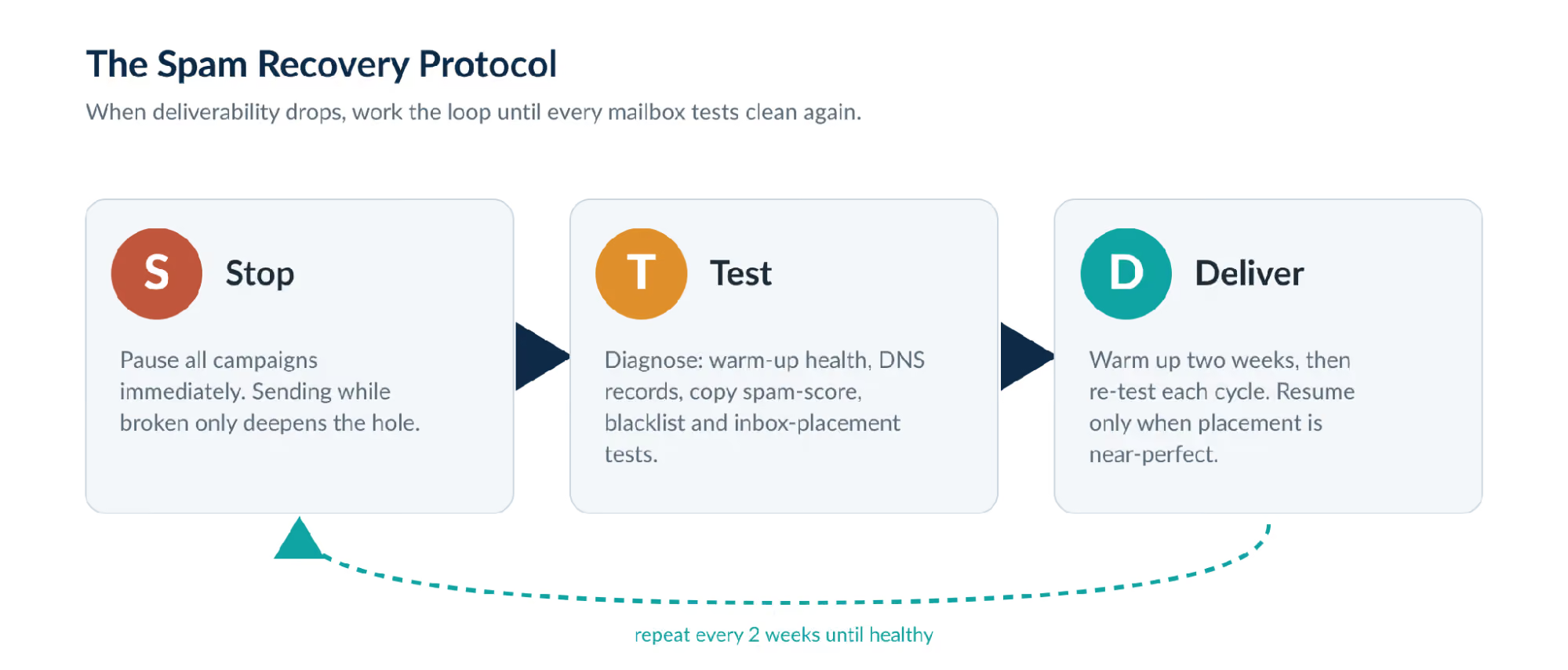
Worried your domains are already burned? Reply and we’ll run a free placement test and tell you exactly where you stand. No form, no pitch, just the diagnosis.
Ordered list
Unordered list
Bold text
Emphasis
Superscript
Subscript



.svg)
