


Get actionable strategies every Week
Oliver joined CircuitHub in November 2017 as Head of Sales, later becoming Chief Revenue Officer. The business was an electronics manufacturing and software company focused on printed circuit board assembly, operating between London and Western Massachusetts, near Boston.
It had around eight employees, a few million dollars in revenue and early traction with startup customers. Oliver was the first dedicated commercial hire, with a mandate to build the sales engine from the ground up.
CircuitHub sold a complex technical product to engineering teams. The buyer was usually an engineer designing or iterating an electronic product, who needed assembled PCBs made quickly, reliably and at growing scale.
There were early adopters, but no repeatable sales motion. The business had to identify the right buyers, build a structured outreach process, answer technical questions credibly, and move beyond small startups into larger organisations.
Above all, the sale had to scale. Customers needed trust before placing bigger orders, so the job was to reduce manual friction and shorten the path from evaluation to repeat usage.
Oliver built a structured motion: targeting the right companies, finding the right people inside them, running outbound email and LinkedIn cadences, and setting up demos. Ad hoc early traction became a process that could be measured and improved.
Rather than run a generic sales process, Oliver put CircuitHub’s technical people in front of customers. Engineering buyers got credible answers from credible people, which built confidence and de-risked larger commitments.
Working with the product team, Oliver made more of the process self-serve. Greater automation and machine-learning-led decisioning cut manual inputs and let customers order with less friction.
The model became land and expand. CircuitHub could start with one engineer, team or department, prove value on a prototype order, then expand into other teams and larger projects inside the same company.
During Oliver’s tenure, CircuitHub grew from a few million dollars in revenue to approximately $20m ARR, and from around eight people to roughly 70 to 80 employees.
The sales cycle shrank by about 40%, driven by better process, a stronger product experience, closer technical collaboration and more self-serve capability. Customers typically started with prototype orders and, once trust was earned, expanded into full-scale manufacturing runs, lifting average order value.
Major logos acquired during Oliver’s tenure included:
NASA, Uber, Tesla, Apple, Meta, Google, Amazon, Netflix, Warner Bros, Toyota, Ford and General Motors.
A few million dollars in revenue to around $20m ARR, with the sales cycle cut by about 40%.
Oliver built the first commercial engine for a genuinely complex business. CircuitHub did not need a volume sales team. It needed a motion that could earn trust with engineers, support technical evaluation, and turn a first prototype into a long-term manufacturing relationship.
The result was a scalable revenue function, a shorter sales cycle and a customer base that grew from startups into some of the world’s most recognisable technology, automotive, media, aerospace and government organisations.
From early-adopter demand to a scalable land-and-expand revenue engine: technical B2B selling where trust, product experience and engineering credibility drove the growth.
Lorem ipsum dolor sit amet, consectetur adipiscing elit, sed do eiusmod tempor incididunt ut labore et dolore magna aliqua. Ut enim ad minim veniam, quis nostrud exercitation ullamco laboris nisi ut aliquip ex ea commodo consequat. Duis aute irure dolor in reprehenderit in voluptate velit esse cillum dolore eu fugiat nulla pariatur.
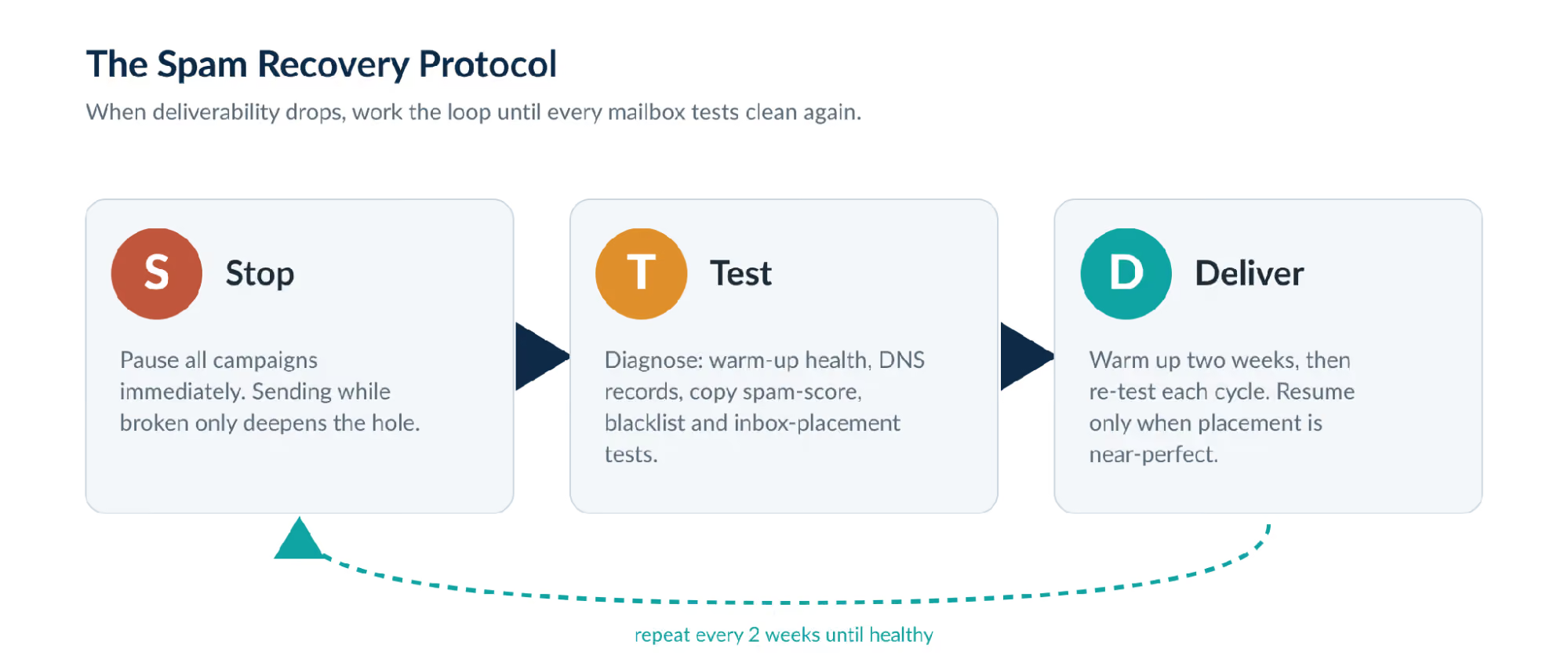
Worried your domains are already burned? Reply and we’ll run a free placement test and tell you exactly where you stand. No form, no pitch, just the diagnosis.
Ordered list
Unordered list
Bold text
Emphasis
Superscript
Subscript



.svg)
